Research Paper
Who May Levy What - Local Government Taxing Authority in Ohio and the Legal Steps Required to Change It
Maps the principal taxing authority of Ohio municipalities, counties, townships, and school districts and explains what legal action would be required to change it.
Read the Complete White Paper
Download the original Ohio Common Ground white paper, including its complete analysis, notes, tables, and source documentation.
Format: PDF
Type: White Paper
RESEARCH Overview
Executive Summary
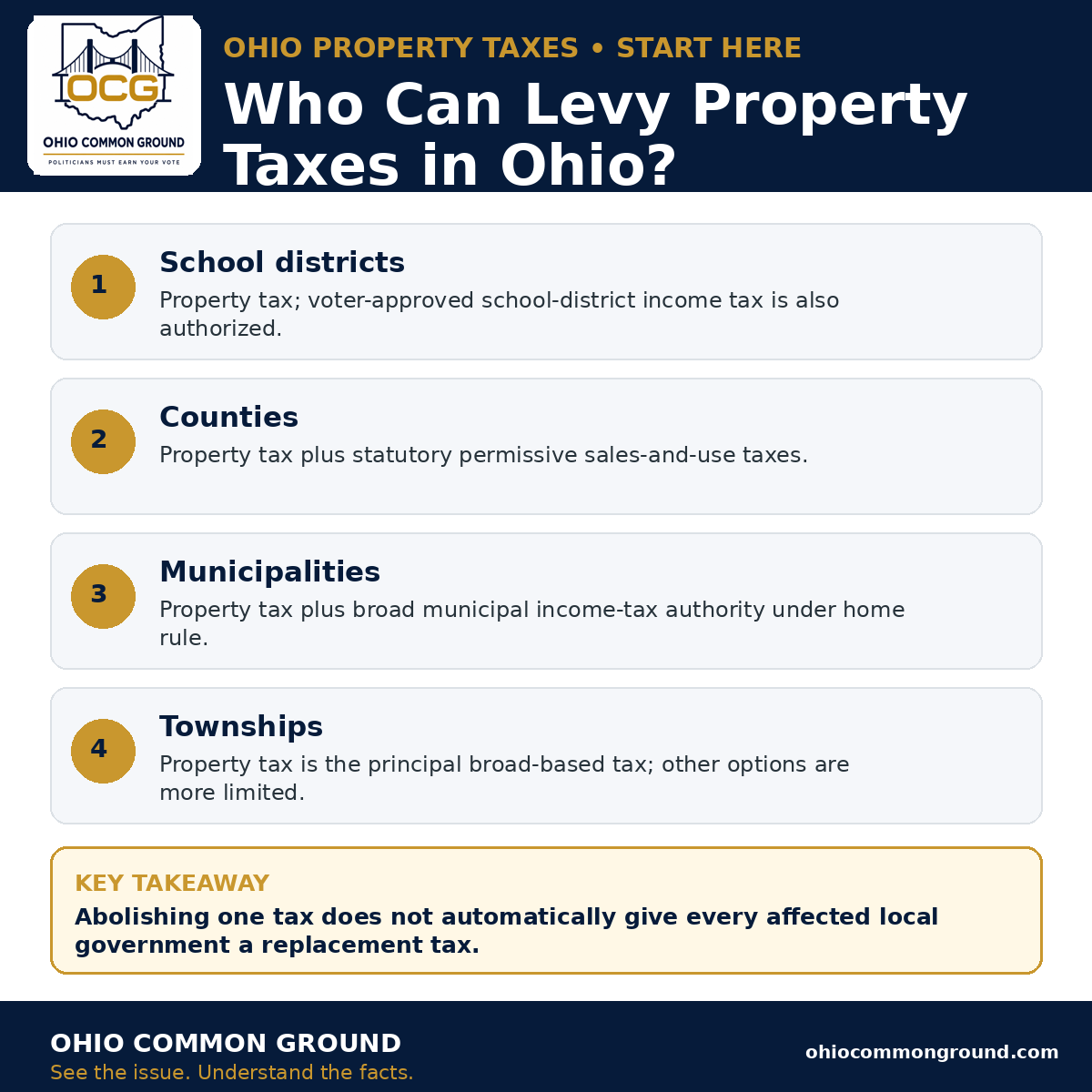
Ohio local governments do not all possess the same power to raise revenue. Municipalities have broad constitutional home-rule taxing authority, while counties, townships, and school districts generally may levy only taxes expressly authorized by the General Assembly.
The distinction is central to property-tax replacement because real-property tax is the one broad-based tax available to every major class of local subdivision.
Insights
Key Findings
- Home rule divides the field.
- Income-tax authority is uneven: municipalities and school districts have general subdivision-wide mechanisms; counties and townships do not.
- County sales-tax authority exists by statute.
- Townships have the narrowest broad-based toolkit.
- Eliminating one revenue source does not automatically grant authority to impose another.
Framework
Methodology & Scope
Statements of taxing authority are drawn from the Ohio Constitution and operative statutes, supplemented by controlling judicial authority, Attorney General opinions, LSC analyses, and administrative guidance. Law status: July 22, 2026.
context & qualifications
Limitations & Notes
Not an exhaustive catalog of every special-purpose entity or financing mechanism. No revenue yields are modeled and no new taxing authority is recommended. Contested constitutional questions are flagged rather than resolved.
Explore the Findings

Access the Complete Research Report
Download the full PDF version for offline reading, complete data tables, and citation details.
Download PDF Document