Research Paper
Replacing Ohio Property Tax Revenue — An Evaluation of the Options
Evaluates the principal mechanisms available to replace, offset, or reduce reliance on Ohio real-property-tax revenue without recommending a preferred approach.
.png)
Read the Complete White Paper
Download the original Ohio Common Ground white paper, including its complete analysis, notes, tables, and source documentation.
Format: PDF
Type: White Paper
RESEARCH Overview
Executive Summary
If Ohio reduces or eliminates real-property-tax revenue, what mechanisms are available to fund the services that revenue currently supports? This paper evaluates that question rather than advocating a preferred answer.
Using a Legislative Budget Office baseline, it identifies approximately $21.41 billion in TY2024 real-property taxes and examines sales and income taxes, spending reductions, retained or narrowed property taxation, targeted relief, supplemental revenues, local-option taxes, greater state assumption of school funding, economic growth, and hybrid approaches.
Insights
Key Findings
- Scale: $21.41 billion is the TY2024 real-property-tax reference base; schools accounted for 63.6%.
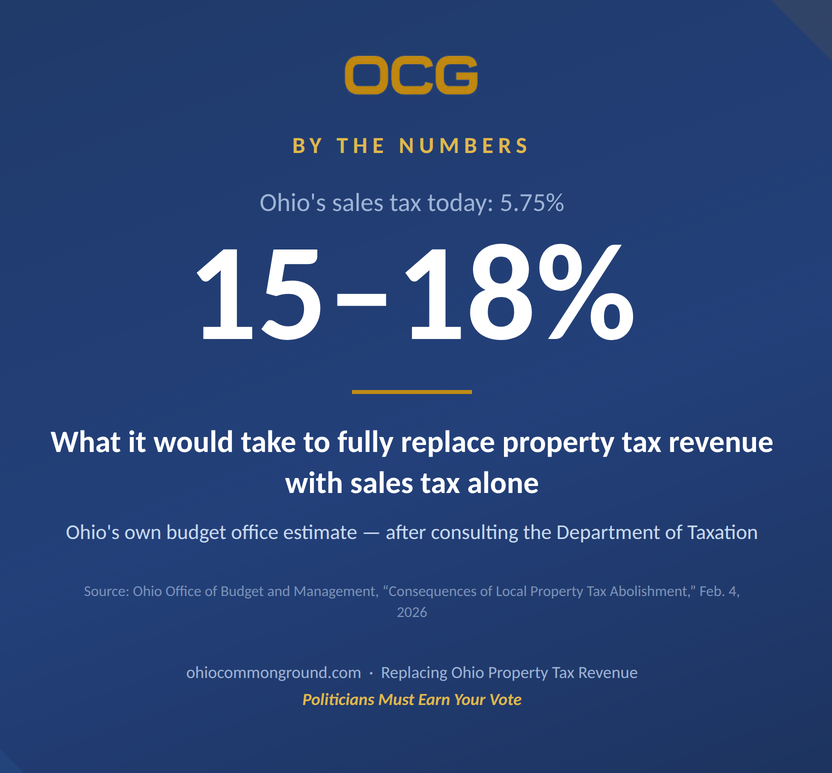
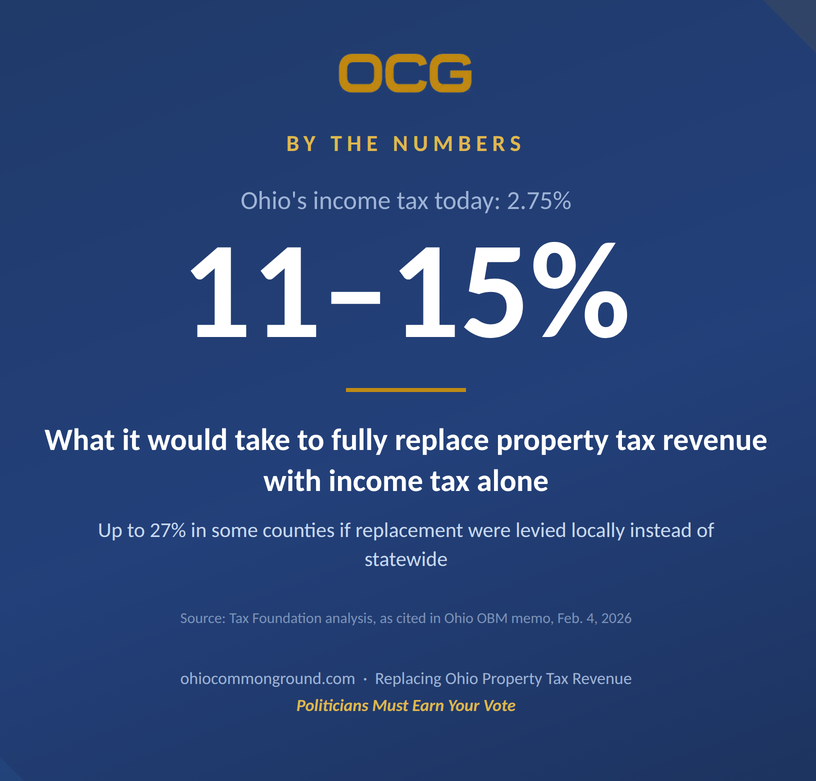
- Single-tax replacement is large: cited scenarios put sales tax at roughly 15%–18% or income tax at roughly 11%–15% if used as the principal replacement.
- Smaller sources fit hybrid approaches.
- Transition matters: debt, fixed-sum levies, school operations, and revenue allocation raise additional questions.
Framework
Methodology & Scope
Primary state fiscal analyses establish the baseline. Rate and dollar estimates are attributed to their originating sources. Different meanings of “replacement” are kept distinct and options are compared rather than ranked.
context & qualifications
Limitations & Notes
No preferred policy is recommended. Scenario estimates are not forecasts. Unresolved legal and credit questions are identified rather than settled; time-sensitive figures should be read with their source vintages.
Explore the Findings

Access the Complete Research Report
Download the full PDF version for offline reading, complete data tables, and citation details.
Download PDF Document