Research Paper
The Price of the Silicon Heartland
Examines Ohio's data center sales-tax exemption program, forgone state and local tax revenue, contractually required long-term jobs, construction-phase tax effects, and comparisons with other states.

Read the Complete White Paper
Download the original Ohio Common Ground white paper, including its complete analysis, notes, tables, and source documentation.
Format: PDF
Type: White Paper
RESEARCH Overview
Executive Summary
Ohio has used a state sales-and-use tax exemption on data center equipment and construction materials, layered with local property-tax abatements and in some cases state job-creation tax credits, as a major tool for attracting large-scale data center investment since 2013.
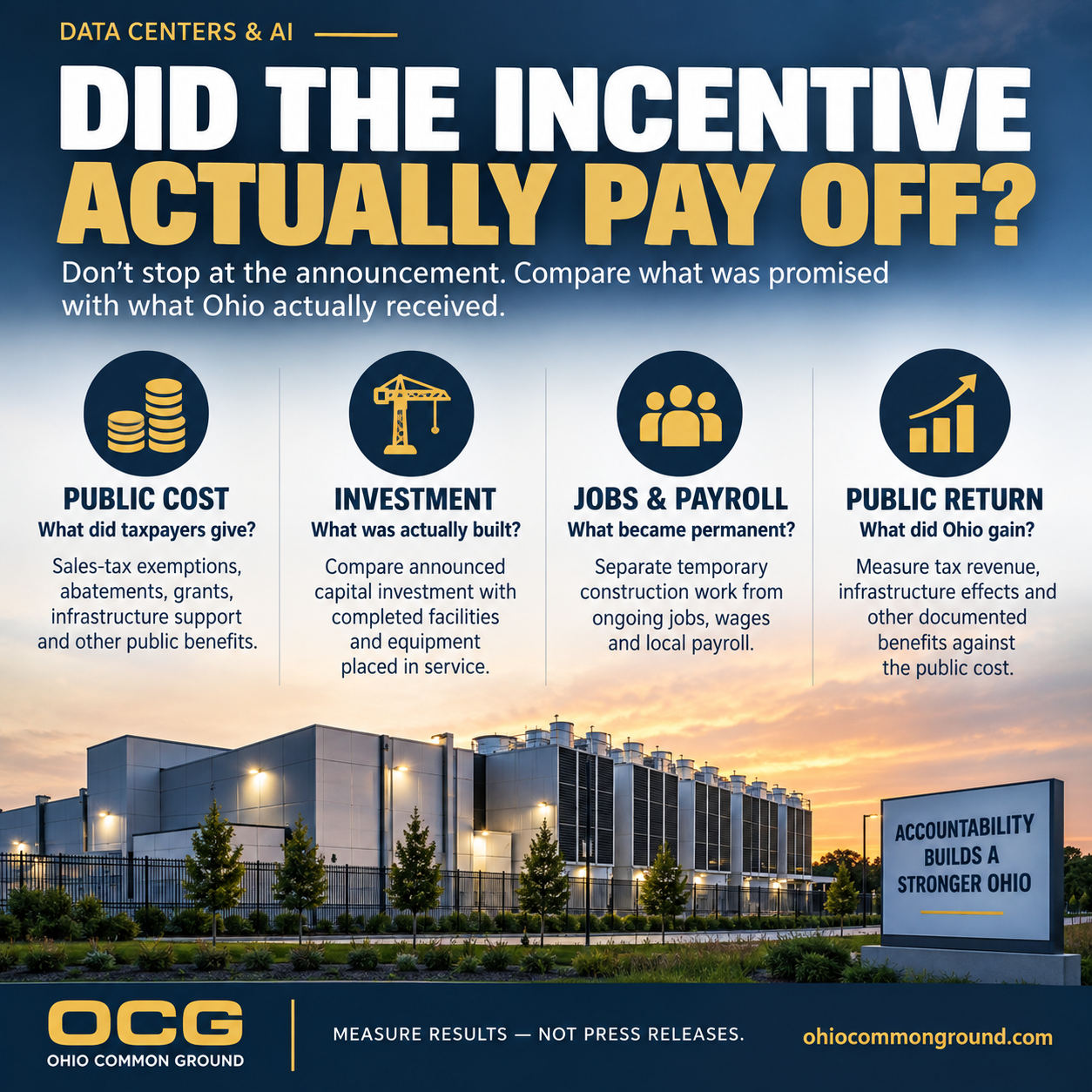
This paper examines why Ohio adopted that approach, how much tax revenue has been forgone, how those figures compare with contractually required long-term jobs, what tax revenue the construction and development phase generates, and how Ohio's program compares with selected other states.
Insights
Key Findings
- State exemption costs rose sharply. The paper reports Ohio's state sales-tax exemption cost increasing from $554.9 million in FY2024 to $1.568 billion in FY2025.
- Per-required-job figures vary substantially by agreement. Selected agreements range from roughly $470,000 to more than $3.6 million in forgone state sales tax per contractually required long-term job.
- Construction does not restore the exempted sales tax. Qualifying construction materials can be covered by the same exemption; construction-related public revenue is instead concentrated in other taxes such as payroll withholding and contractor receipts, for which sector-specific totals are not separately published.
- Ohio is not unique. The paper identifies at least 37 states with some form of data-center sales-tax exemption and compares Ohio with selected other state programs.
Framework
Methodology & Scope
The paper relies on publicly available information from the Ohio Department of Taxation, Ohio Department of Development, Ohio Tax Credit Authority, Ohio Revised Code, public tax agreements, legislative fiscal documents, and identified secondary reporting. Estimates are labeled separately from officially reported statistics and assumptions are stated where estimates are used.
The scope is fiscal: incentives, forgone revenue, jobs attached to agreements, construction/development tax effects, and selected interstate comparisons. It does not evaluate electric-grid, water, environmental, or land-use impacts.
context & qualifications
Limitations & Notes
No single public ledger combines Ohio's state sales-tax exemptions, Job Creation Tax Credits, and local property-tax abatements. Forecasts have been volatile, disclosure limits constrain project-level verification, and different sources use different denominators when describing jobs or economic effects.
The paper does not quantify supplier spending, local hospitality demand, utility investment, multiplier effects, or technology-sector clustering because the public record does not support defensible dollar estimates for those categories. The paper is descriptive rather than prescriptive and makes no recommendation on whether the exemption should continue, change, or end.
Explore the Findings
Access the Complete Research Report
Download the full PDF version for offline reading, complete data tables, and citation details.
Download PDF Document