Research Paper
Has Ohio Been Defunding Public Education?
Examines two decades of Ohio public-school funding, enrollment, spending, state/local shares, scholarships, and competing claims about whether education has been “defunded.”
Read the Complete White Paper
Download the original Ohio Common Ground white paper, including its complete analysis, notes, tables, and source documentation.
Format: PDF
Type: White Paper
RESEARCH Overview
Executive Summary
Two slogans dominate Ohio's school-funding debate: that public education has been “defunded” for decades, and that schools have “never had more money.” This report asks what actually happened to the money supporting Ohio public schools.
The central finding is structural: apparently contradictory facts can be simultaneously true because “funding” can mean total or per-pupil dollars, nominal or inflation-adjusted dollars, state share or combined state-and-local revenue, or formula-calculated versus appropriated funding.
Insights
Key Findings
- Funding is not one number.
- Long-run growth: revenue and spending rose in nominal, inflation-adjusted, and per-pupil terms.
- Enrollment fell 8.3% over the long-run series while real operating expenditure per pupil increased about 26%.
- State share declined from roughly 42% to 36% in the all-funds series.
- Scholarship spending increased from roughly $175 million in FY2014 to about $1.10 billion in FY2025.
Framework
Methodology & Scope
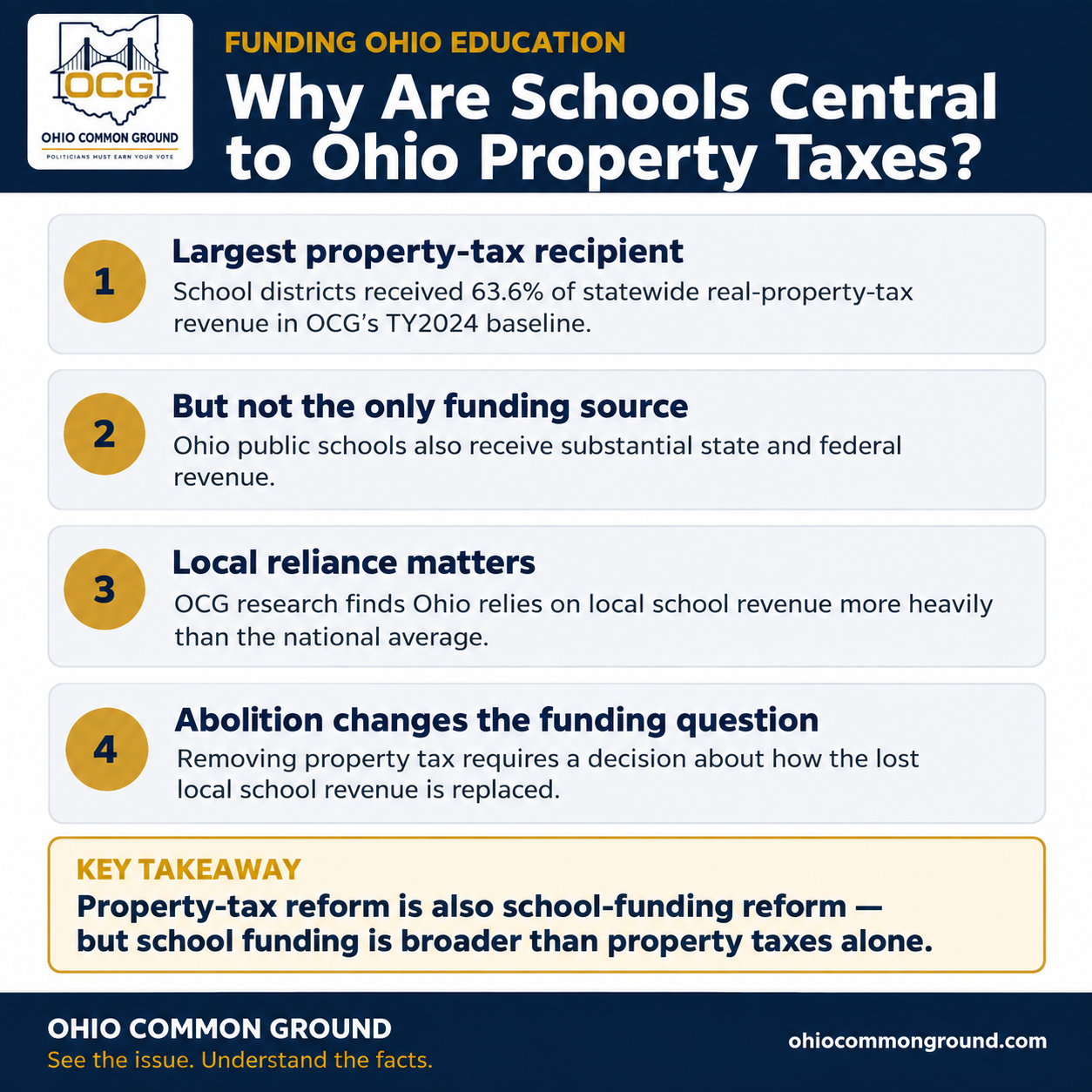
Figures come from Ohio and federal primary sources. The paper keeps distinct funding universes separate: all-funds revenue/expenditure, state appropriations, foundation-delivered aid, and scholarship payments. Nominal, real, total, per-pupil, state-share, and formula measures are not conflated.
context & qualifications
Limitations & Notes
Descriptive, not evaluative. No judgment is made on adequacy, fairness, or policy wisdom. The paper evaluates a defined set of claims, makes no causal estimate between funding and outcomes, and uses mixed data vintages that are not treated as interchangeable.
Explore the Findings
Access the Complete Research Report
Download the full PDF version for offline reading, complete data tables, and citation details.
Download PDF Document